
The Self-tuning Prompt
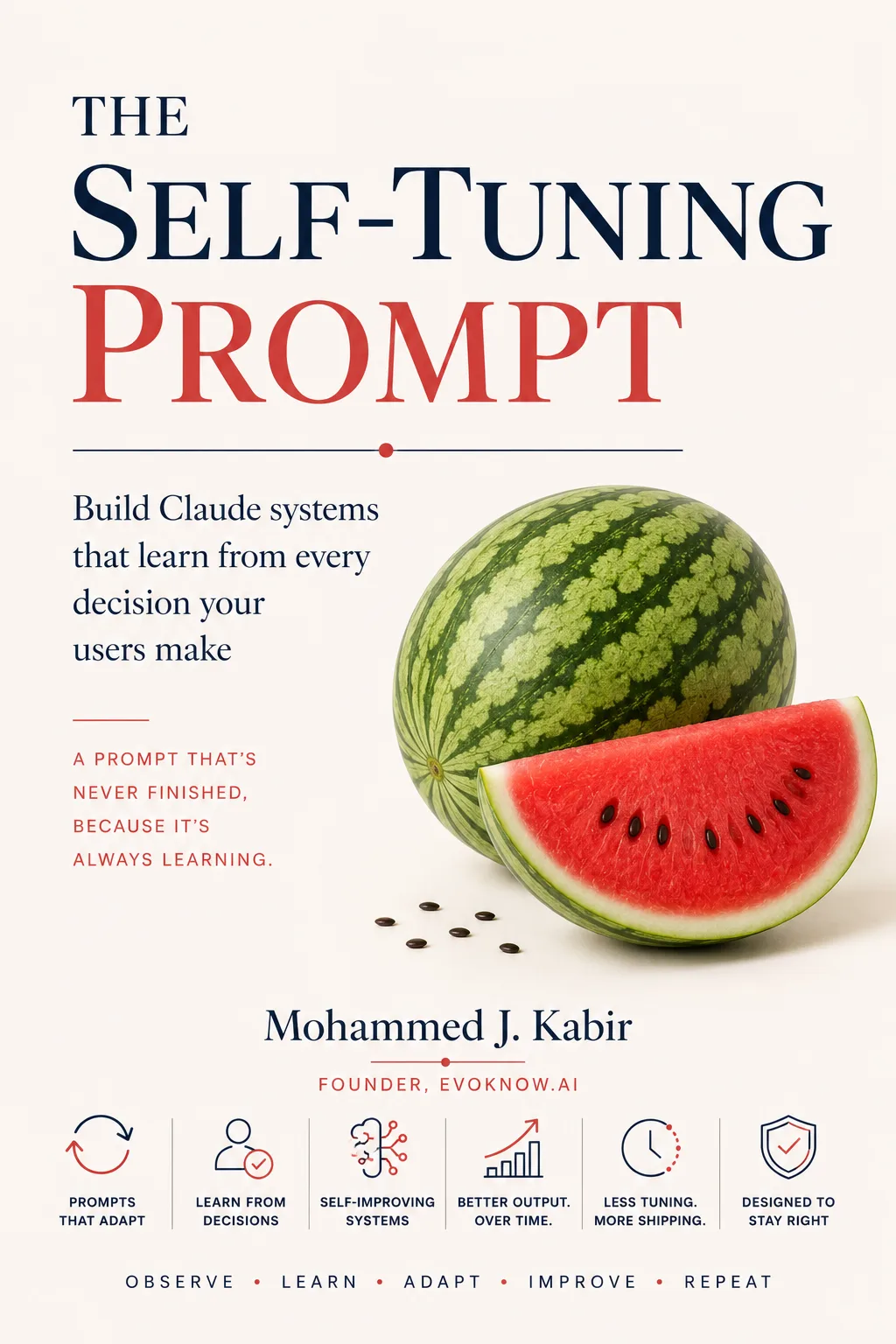
Build Claude systems that learn from every decision your users make
One of Anthropic's clients opened a single role and got more than 2,700 applications in 24 hours. The recruiter wrote her AI assistant a brief: five years of backend, startup background, strong Python. Two days later she looked at who she'd actually liked — and her brief was already describing the wrong person. She hadn't even reached the second hundred.
No prompt you write by hand stays right that long. The people who feel this most are the ones building real systems: the prompt was correct on Monday and quietly wrong by Wednesday, and nobody notices until the output stops being useful.
This book is about the fix. Instead of writing a better one-time prompt, you build a system where the prompt watches what your users actually decide and rewrites itself in the background — so by the time their preferences shift, the prompt has shifted with them. No engineer tuning words every week. The loop does it.
In seven short chapters, you'll build the whole thing piece by piece:
- Why hand-written prompts go stale — and why drift is structural, not a failure of foresight
- The mental shift that makes self-improvement possible: a prompt is not a config, it's an apprentice
- The hundred-decision rule: why updating on every click chases ghosts, and patience finds signal
- The two-layer architecture — a cheap evaluator on every input, a smart apprentice on batches — that keeps the system alive in production instead of bankrupting it by lunchtime
- Why you write the prompt in prose, not rules, so it can actually be rewritten
- How the four pieces snap together into a feedback loop that runs on its own
- Where the pattern fits (recruiting, support triage, moderation, code review, deal scoring) — and where it doesn't
A recurring cast carries the ideas through real situations, and every chapter ends with a method box and a same-day exercise so you leave with a tool, not just an anecdote. Eight custom diagrams make the architecture concrete, and a one-page "At a Glance" reference, a glossary, and a closing note round it out.
If you've been treating your prompt as a deliverable you finish, this book offers the alternative the fastest teams already use: a prompt that's never finished, because it's always learning. Build it as a loop from day one and you stop spending your weeks tuning words — and start spending them shipping the product.
Around 9,000 words. For engineers and product builders shipping LLM-powered systems where a human makes the judgment calls and the model helps.
An independent work. The framework's terminology is credited to the practitioners who developed it; the prose, characters, and examples are original.
- pdf · 3.5 MB Email to unlock
Sign in to join the discussion.